

Café · Manchester · ⭐ 9.7/10 · 1032 reviews · updated: 2026-08-10 17:33:43
Address: 1 Nobel Wy., Manchester M1 7FT, United Kingdom
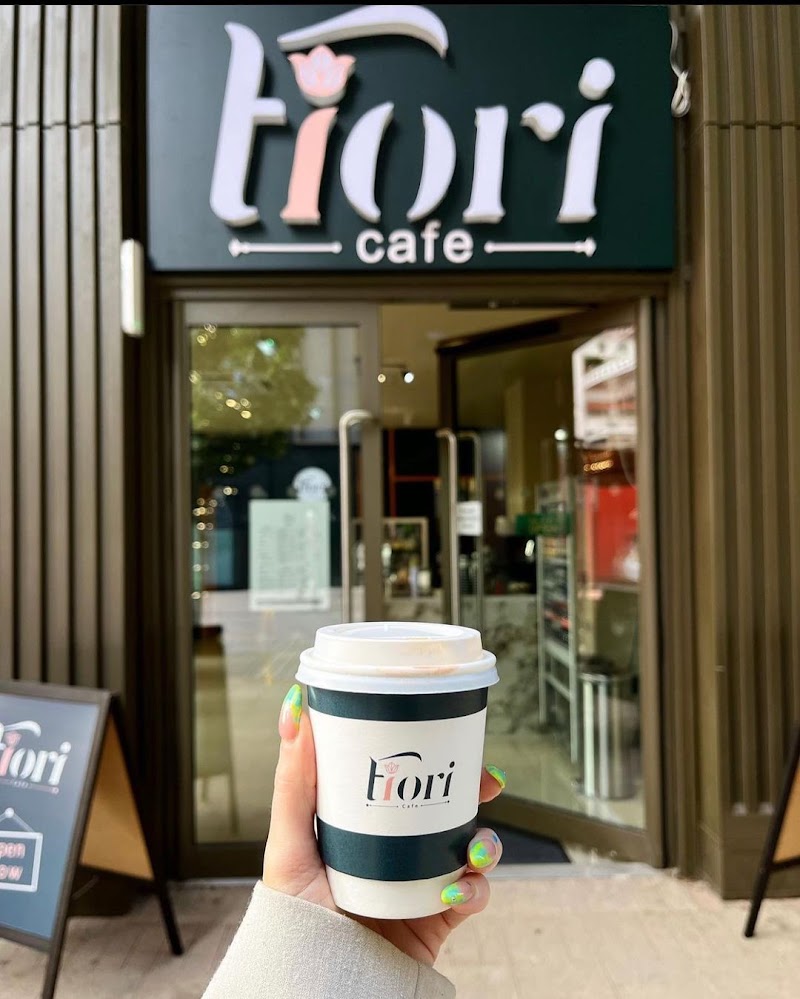
Most of Manchester’s coffee arguments are about espresso — which roastery, which grinder, which brew bar. Fiori Cafe sidesteps that whole conversation by pouring something else entirely: sahlab, karak, cardamom-heavy Arabic coffee and milk drinks scented with rose and pistachio. It occupies a glass-walled ground-floor unit in Circle Square, the newest quarter on the southern side of the city centre, and it is one of very few rooms in Manchester where the default hot drink is not a flat white.
Highlights
- An Arabic coffee house, not a specialty espresso bar — the drinks list is built around Middle Eastern tradition rather than around a rotating single-origin filter.
- Sahlab as the house signature — a thick, warm, gently spiced milk drink that the cafe presents as its own answer to the latte, including rose and pistachio versions.
- Karak done properly — the cardamom-spiced tea that anchors cafe life across the Gulf, alongside Arabic coffee brought to the table in a dallah rather than decanted into a mug.
- Ingredients imported from home — the kitchen brings in what its recipes actually depend on instead of approximating with whatever a British wholesaler can supply.
- A glass box full of daylight — the unit is glazed along its length, which makes it one of the brightest cafe interiors in this part of town.
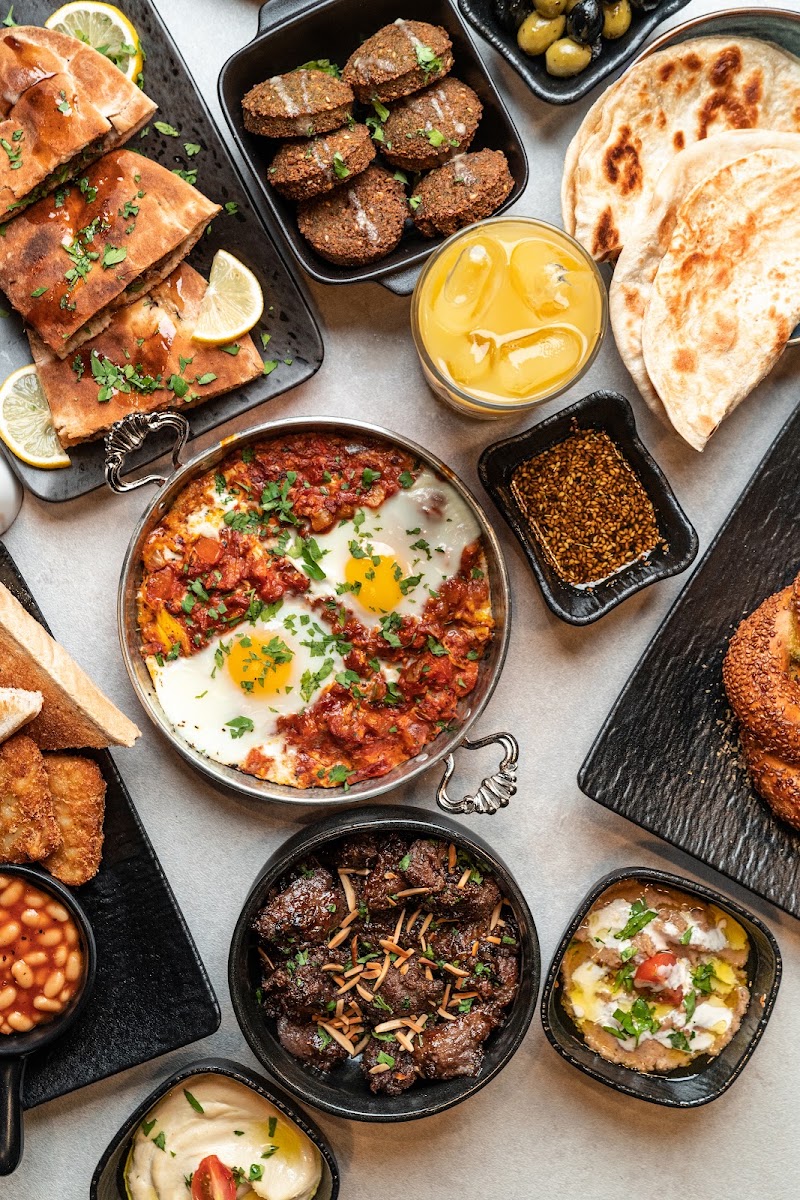
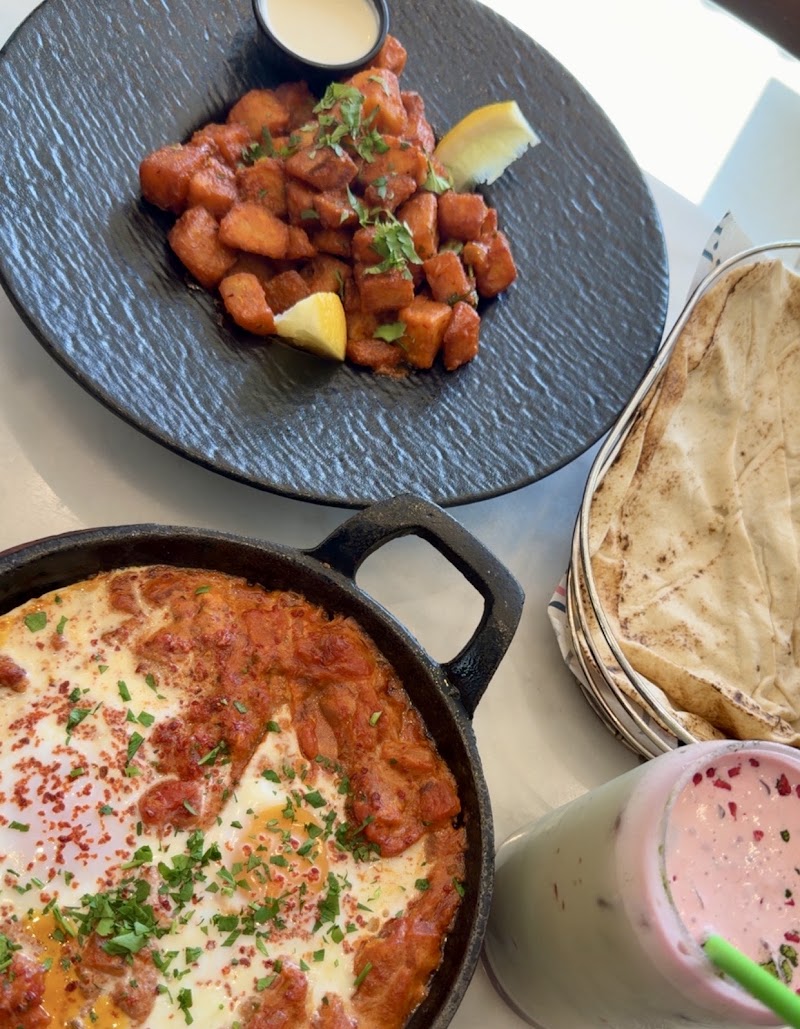
- Nothing beige on the plate — beetroot borani, batata harra, eggs on simit and saffron milk cake all arrive looking as though the colour was part of the recipe.
What’s in the cup
The starting point here is not espresso. Fiori is built around the drinks of the Arab and Turkish coffee house, and the clearest expression of that is sahlab — a hot, thickened, lightly spiced milk drink that has been poured across the eastern Mediterranean and the Gulf for centuries. The cafe treats it the way a specialty bar treats the flat white: as the house default, the thing you order when you do not know what to order, and the base for variations. Rose and pistachio are the two people come back for, and both sit closer to a dessert in a cup than to anything on a standard British cafe board.
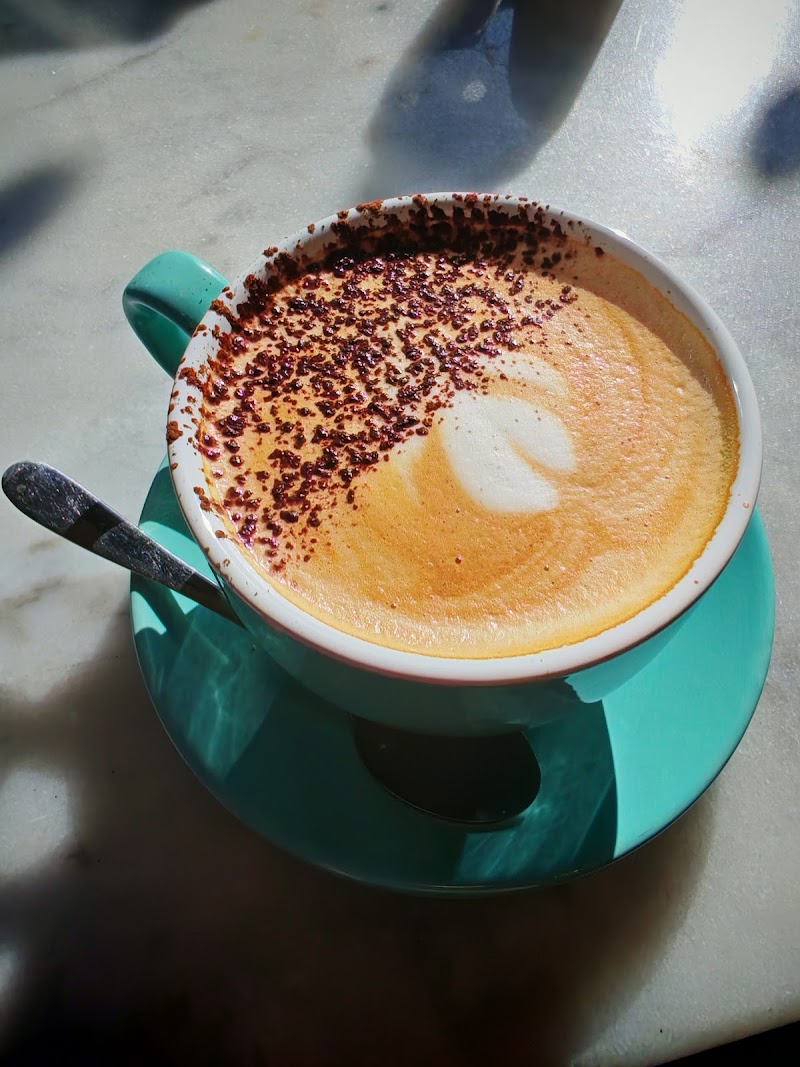
Next to it sits karak, the strong, cardamom-heavy spiced tea that is everyday fuel across the Gulf, and Arabic coffee, which arrives in a dallah — the long-beaked pot that is part of the serving ritual rather than a prop on the shelf. Cardamom does most of the aromatic work, the coffee itself is lightly roasted, and it is poured in small measures, so anyone expecting the dark bitter shot of a European espresso bar will find the entire register unfamiliar. That unfamiliarity is precisely the point of coming.
What Fiori does not do is publish the sort of information a specialty roaster’s customer looks for. There is no named roastery partner, no origin card on the counter, no talk of altitude or processing method. If you want to know which farm your beans came from, this is not that cafe and it makes no claim to be. Western-style espresso drinks are there for the person at the table who wants one, but they are the supporting cast — the reason to make the trip is the half of the list that almost nobody else in central Manchester pours.
Who’s behind it
The cafe was founded by Hamoud Ali Al-Zuhairi, and the company behind it was registered in 2024, which makes Fiori a genuinely recent arrival rather than an institution that has quietly been there for years. The team’s background runs through restaurants and informal eateries in Turkey and further east, and that shows in how the menu is assembled: it reads like a set of dishes people grew up eating rather than a curated “Middle Eastern-inspired” selection put together for a British audience.
The practical consequence is the import list. Rather than approximating flavours with local substitutes, the kitchen brings in the specific ingredients the recipes need. That is a demanding way to run a cafe menu, and it is the most reliable signal available that the concept is sincere rather than decorative. It also explains why several items on the board will be genuinely new to a large share of the people who walk in — this is not a translation of the cuisine into something safer, it is the cuisine.
What it’s good for
Fiori works best as a daytime meeting place: the kind of table where two or three people sit over drinks and a few shared plates for far longer than the drinks strictly justify. The Middle Eastern cafe tradition it draws on is a social one — coffee and tea are the excuse, conversation is the activity, and nobody is counting how long you have been sitting there. That is the visit this room is shaped for, and it is the one that gets the most out of it.
As a laptop cafe it is a less obvious fit. The place does not market itself to remote workers, does not publicise power sockets, and a glass-sided room with strong daylight is not the dim, socket-lined environment that people with a full day of calls tend to hunt for. Students from the neighbouring campuses do settle in, and nobody is moved along, but if a guaranteed plug is a condition of your afternoon it is worth having a fallback in mind before you commit.
It is also a strong choice for the specific job of showing someone the city. Manchester has plenty of very good espresso; it has very little sahlab. If you are hosting a visitor, or you simply want an outing that does not feel like the same cup you had yesterday, this is a small, easily arranged piece of novelty that also happens to be good. Takeaway is possible, but it undersells the place — the ritual of the dallah and the way the sweets are plated are half of what you came for.
The room
The unit is effectively a glass box: a ground-floor space in a modern development, glazed along its long sides, so the room fills with daylight in a way that older Manchester cafe buildings with their brick and their small windows simply cannot manage. On a bright day it is one of the sunniest interiors in this part of the centre. In high summer the same glazing makes the sunny side of the room warm, and the shaded tables quietly become the desirable ones.
The decoration leans into the concept — colour, pattern and a deliberate warmth that reads as a tribute to the founders’ home region rather than as generic hospitality styling. It is a moderate-sized room rather than a cavernous one, so at the busiest stretch of the middle of the day it fills up and the noise level climbs with it. There is space on the square outside, which in Manchester means it is usable for a limited and unpredictable number of days a year, and thoroughly pleasant on those days.
One expectation worth setting: the surroundings are new-build. The immediate outlook is contemporary architecture and landscaped public realm rather than Victorian Manchester, which is either the appeal or the drawback depending entirely on what you came out for.
Beyond the drinks
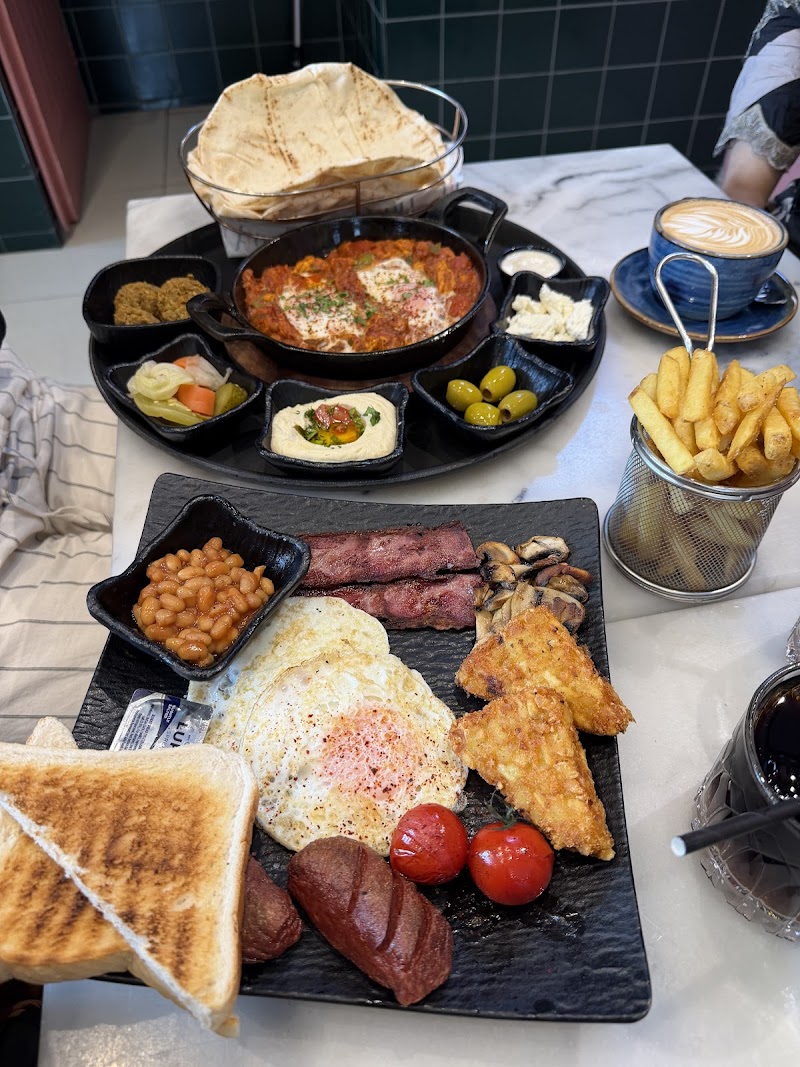
The food is a real kitchen operation rather than a counter of wrapped things bought in from a supplier. Savoury plates are cooked to order and lean Turkish and Levantine — built on yoghurt, pulses, spice and good bread rather than on a sandwich press. Eggs are treated seriously, which is what lets the place function as a brunch destination as much as a coffee stop, and there is a full English on the board for the member of every group who was never realistically going to order anything else.
The sweet side is where the kitchen shows off. Saffron milk cake and umm ali define the register: milky, fragrant, soft-textured desserts from a tradition that does not build its puddings around chocolate and cream. Anyone whose idea of a cafe cake is a wedge of Victoria sponge should expect something genuinely different in both texture and kind of sweetness. Portions assume sharing across a table rather than one person eating alone with a book.
When to come
This is a daytime cafe in the fullest sense. It opens for breakfast and winds down through the afternoon rather than carrying on into the evening, so it belongs to brunch, lunch and the long middle of the day, not to a night out. The busiest stretch is the middle of the day at weekends, when the brunch trade and the neighbourhood’s residents arrive together; a weekday morning is the calmest window and the best one if you want a table against the glass.
Term time matters here more than in most of the city centre. The surrounding quarter carries a large student and postgraduate population, and the rhythm of the room shifts noticeably between the university year and the long summer gap. If you want the place at its liveliest, come in term; if you want it quiet, take the opposite advice.
Getting there
Fiori sits in Circle Square, the redevelopment built on the ground the BBC occupied before it moved out to Salford — a landmark most long-standing Mancunians still navigate by. It is at the southern end of the city centre, in the belt between the main shopping core and the universities, and it is a walk of a few minutes from St Peter’s Square.
By train, Manchester Oxford Road station is the closest stop and leaves you a short walk away. The tram network serves the northern side of the area rather than the door itself, so the final stretch is on foot however you arrive. Driving into this part of the centre is possible but rarely the sensible option: the development is laid out around pedestrians and public squares, and kerbside parking in the immediate area is scarce.
Good to know
Come with an appetite for unfamiliar things. The commonest mistake here is to order a cappuccino and a slice of something safe, which turns a distinctive cafe into an ordinary one. The drinks that justify the trip are the ones you cannot picture yet, and staff are used to explaining what sahlab and karak actually are — asking is the right move rather than an imposition.
Be aware, equally, of what the cafe does not tell you. It says almost nothing publicly about its espresso sourcing, its seating capacity or its facilities, and it is a young business still writing its own story. Some of the detail a coffee enthusiast would want simply has not been published, and nobody should fill that gap with guesswork. What is on the record — the founder, the concept, the imported ingredients, the drinks themselves — is unusually clear for a cafe this new.
Questions and answers
Is this a specialty coffee shop?
Not in the third-wave sense. There is no named roastery partner and no rotating single origin. The speciality here is Arabic and Middle Eastern drink culture — sahlab, karak, cardamom coffee — which is a different tradition rather than a weaker version of the same one.
What should I order on a first visit?
Sahlab, in one of the flavoured versions, and karak as well if there are two of you and you want to cover both traditions. If you are eating, one savoury plate plus one of the milk-based desserts shows you more of the kitchen than two savoury dishes would.
Can I work here with a laptop?
People do, and the campuses next door guarantee a student contingent, but the cafe does not present itself as a work space and does not publicise its power sockets. For an hour with a notebook it is fine; for a full working day, look at the room before you settle in.
Is it suitable for a group?
Yes. The food is built for sharing and the social model behind the whole concept assumes a table of people rather than a solo customer. Larger groups are better off steering clear of the weekend brunch peak.
Is there anything for someone who does not drink coffee?
More than at most cafes. Karak is tea, sahlab is a milk drink, and both are house specialities rather than afterthoughts. A non-coffee drinker is arguably better served here than a flat-white loyalist.
Is there outdoor seating?
There is space on the square outside, which is a pleasure when the Manchester weather cooperates. Indoors, the glazing gives you most of the daylight without the risk.
How long has it been open?
Not long. The company behind it was registered in 2024, so this is a young cafe still building its reputation rather than a long-established fixture.
Is it a good place to bring someone visiting Manchester?
One of the better ones, precisely because it is not what a visitor expects a Manchester cafe to be. The city’s espresso scene is strong but familiar; this is the drinks list they will not have had at home.
Opening hours
| Day | Hours |
|---|---|
| Monday | 09:00–17:00 |
| Tuesday | 09:00–17:00 |
| Wednesday | 09:00–17:00 |
| Thursday | 09:00–17:00 |
| Friday | 09:00–17:00 |
| Saturday | 09:00–17:00 |
| Sunday | 09:00–17:00 |
Photos
Visitor reviews
Reviews last updated: 2026-08-10 17:33:43
Data is refreshed monthly. Sources: manchesterka.com and editorial picks based on reviews.
Кафе «Фіорі» – це чудова перлина недалеко від Оксфорд-роуд. Воно було в моєму списку місць для відвідування, і я не розчарувався. Персонал привітний і уважний. Вони запитали про алергії, яких у мене немає, але я був враж…
Замовив авокадо на тості з яйцем. Було досить смачно, оскільки його подавали на хлібі бріош, що було освіжаючим варіантом до стандартної страви на сніданок. Це надало йому приємної м’якої солодкої текстури.
Я також замо…
Прийшов сюди сьогодні сам на пізній сніданок. У кафе був дуже гарний інтер'єр, а персонал був дуже привітним. Я замовив порцію їхньої патати з яєчнею та ковбасою. Їхній крижаний лате тірамасу був неймовірним, як і команд…
Це чудове місце з теплою, гостинною атмосферою. Персонал щиро доброзичливий, що робить враження ще кращим. Їжа чудова, мої особисті улюблені – це арайєс та французькі тости, обидва сповнені смаку та чудово приготовані. Н…
«Фіорі» – це затишне кафе в Манчестері, де можна насолодитися смачним фісташковим лате та різноманітними варіантами бранчу. Я дуже рекомендую турецьку ковбасу – вона справді смачна і достатньо велика для двох!
Однак шафр…