

Many Manchester residents have heard of Enriqueta Augustina Rylands, remembered as one of the city’s most remarkable philanthropists. She was one of the first women to challenge societal expectations of her time, significantly influencing Manchester’s cultural, social, and intellectual landscape during the 19th century. Next on manchesterka.com.
Enriqueta’s life underwent a profound transformation after her marriage to John Rylands, one of Manchester’s wealthiest industrialists. Following his death, she dedicated herself to preserving his legacy—not only in memory but as a lasting benefit to generations of students, scholars, and readers. Her efforts culminated in the creation of the John Rylands Library in industrial Manchester. This library, a world-class institution, remains one of Manchester’s most treasured landmarks in the 21st century.
Early Life of Enriqueta Augustina Rylands
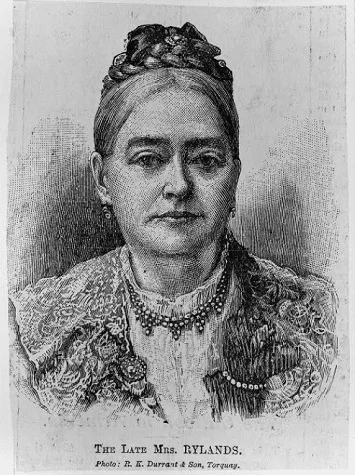
Born Enriqueta Augustina Tennant in Cuba in 1843, she came from a wealthy family of merchants. Her father, Stephen Cattley Tennant, was a Yorkshire merchant, and her mother, Juana Camila Dalcour, remarried Polish pianist and scholar Julian Fontana after Stephen’s death in 1848. Enriqueta had four full siblings and a half-brother, Julian Camillo Adam Fontana, from her mother’s second marriage.
Enriqueta received a Catholic upbringing and completed her education in New York, London, and Paris. Later, she converted to Congregationalism under the influence of Reverend Thomas Raffles. The family moved to Britain during her childhood, where Enriqueta grew up in a society that often devalued women and restricted their roles to the domestic sphere. However, her privileged upbringing provided her access to educational resources unavailable to most women of her time.
Her future took a decisive turn through her marriage to John Rylands, a successful Manchester industrialist renowned for his vast textile empire. Despite the significant age difference—he was 74 and she was 32—their deep intellectual connection and shared commitment to public welfare bound them together.
Marriage to John Rylands
John Rylands was a prominent figure in 19th-century Manchester, known for his contributions to the city’s industrial growth and welfare initiatives. He funded churches, schools, and housing for the poor while supporting various civic projects.
Enriqueta initially entered the Rylands household as a companion to Martha Rylands, John’s first wife, and became a member of the Cavendish Congregational Church. After Martha’s death in 1875, Enriqueta and John married eight months later. Although the marriage was childless, they adopted two children: Arthur Forbes, Enriqueta’s cousin, and Maria Castiglioni. Upon John’s death in 1888, Enriqueta inherited the majority of his wealth, becoming the primary shareholder in the family’s textile company and the Manchester Ship Canal.
Philanthropic Work of Enriqueta Augustina Rylands
After John Rylands’ death, Enriqueta faced the challenge of how to use her significant inheritance. Rather than expanding her husband’s business ventures, she chose to honor his memory by dedicating her resources and energy to a monumental project: the creation of the John Rylands Library. Her goal was not merely to establish a library but to create a revolutionary cultural space accessible to all Manchester residents.
The library was designed to house a world-class collection of rare manuscripts and books. Enriqueta curated important works from across Europe, including illuminated texts, biblical manuscripts, and significant theological, philosophical, and scientific writings. In 1892, she discreetly purchased the famed Spencer Collection for £210,000, securing rare volumes of global significance.
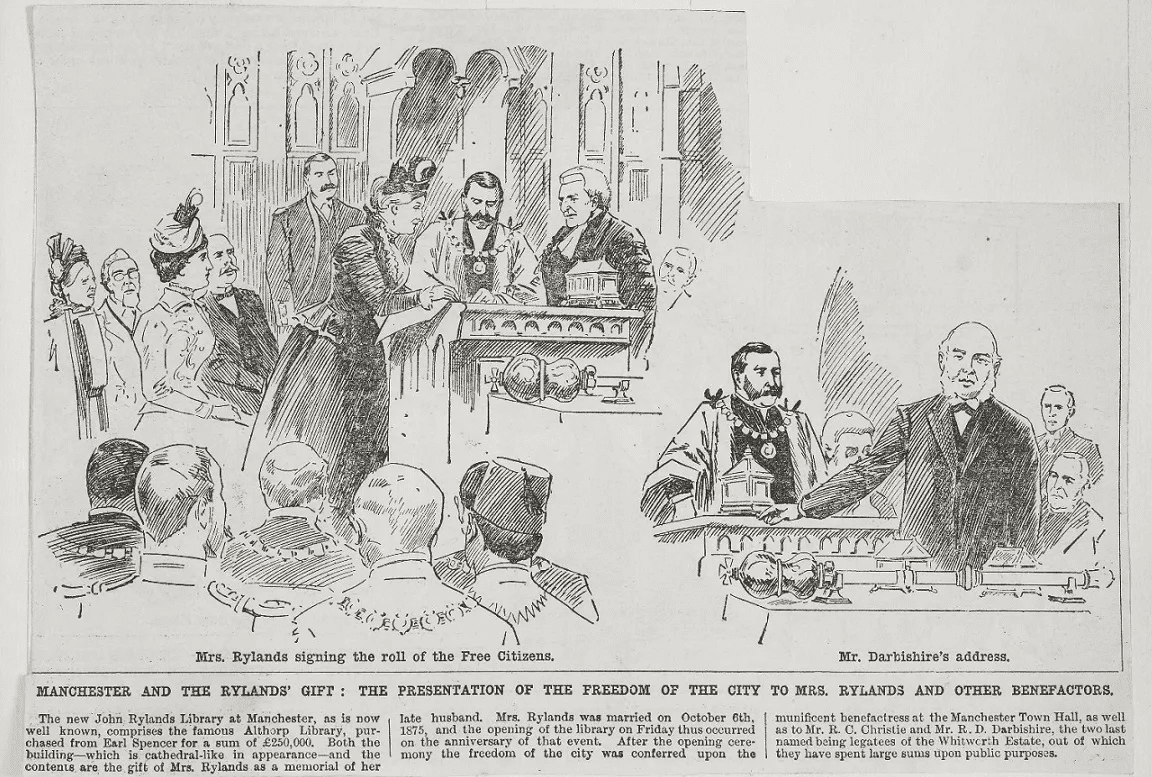
Enriqueta commissioned the English architect Basil Champneys to design the library, inspired by the Mansfield College in Oxford but with greater grandeur. The John Rylands Library officially opened on 6 October 1899, a date chosen to commemorate her wedding anniversary with John Rylands. That same day, she became the first woman to be granted the Freedom of the City of Manchester.
She devoted the remainder of her life to charitable and missionary work, bequeathing much of her fortune to educational and medical institutions, including the Victoria University of Manchester and the library she founded.
Even after the library’s opening, Enriqueta actively expanded its collection. In 1901, she acquired the Lindesiana Library for £155,000, adding over 6,000 rare manuscripts. This private collection, belonging to James Lindsay, 26th Earl of Crawford, was one of Britain’s most significant, enhancing the John Rylands Library’s global reputation.
Legacy and Final Years
Enriqueta Augustina Rylands, a visionary philanthropist and cultural pioneer, passed away in 1908 at the age of 64 after years of struggling with rheumatic symptoms. She left an enduring legacy in Manchester’s literary and cultural spheres, with the John Rylands Library standing as a testament to her dedication to education and knowledge.
Source:
- https://medium.com/special-collections/enriqueta-rylands-philanthropist-founder-of-the-john-rylands-library-7f5761dc2a56
- https://rylandscollections.com/2020/09/14/whiter-than-white-enriqueta-rylands-cuban-roots/
- https://exploringtraffordsheritage.omeka.net/exhibits/show/trailblazing-women-of-trafford/enriqueta-rylands
- https://storymaps.arcgis.com/stories/2bf0ee5021db4e3ba153d59fcd1f0a27